Your website is rarely just a website. For most founders and small-to-medium businesses, it's the single largest marketing asset the company owns: the storefront, the sales deck, the recruiting pitch, and the support channel, all rolled into one URL. So the question of who builds and maintains that site is one of the most important operational decisions a growing company will make.
For companies that have committed to Webflow, that decision usually narrows to two options: hire a specialist Webflow agency, or bring the work in-house with a dedicated developer. Both paths are legitimate. Both work. But they deliver very different economics, very different speeds, and very different long-term trade-offs.
This guide walks through the honest pros and cons of each approach, the real costs you should plan for, and a simple framework to help you choose the option that fits your stage, budget, and growth plan.

What "Webflow Agency" and "In-House Developer" Actually Mean
Before comparing, it's worth defining the two options clearly, because the labels hide a lot of nuance.
A Webflow agency is an external team that specializes in designing, building, and optimizing Webflow sites for clients. A good agency brings designers, developers, SEO strategists, CMS architects, and project managers under one roof. You pay them on a project basis, a monthly retainer, or a hybrid, and you get access to the full team without hiring any of them directly.
An in-house developer is a full-time (or long-term contract) employee who sits inside your company, reports to your team, and owns your site end to end. In practice, this person often wears several hats: front-end development, light design, Webflow CMS work, integrations with your marketing stack, and ongoing maintenance. At smaller companies, the same person may also handle email templates, landing pages, and the occasional HubSpot form.
Both options can ship beautiful, high-performing Webflow sites. The real question is which one fits the way your company actually operates.
The Cost Comparison Most Founders Miss
Cost is usually the first question, and it's also where the most mistakes are made. Founders tend to compare the sticker price of an agency project ("$15,000 for a redesign") to the sticker price of a developer salary ("$75,000 per year") and conclude that the developer is cheaper because the number is spread over twelve months. That comparison is misleading.
The fully loaded cost of an in-house Webflow developer in North America typically ranges from $85,000 to $140,000 per year once you include salary, payroll taxes, benefits, equipment, software licenses, and management overhead. In Europe and parts of Asia, the numbers are lower but the pattern is the same: the true cost is always noticeably higher than the base salary.
A Webflow agency, by contrast, is usually billed one of three ways. A one-off project typically runs from $8,000 to $60,000 depending on scope. A growth-oriented monthly retainer, covering new landing pages, CRO experiments, CMS updates, and performance fixes, usually sits between $2,500 and $10,000 per month. Task-based or "design subscription" models fall somewhere in between.
| Cost factor | Webflow Agency | In-House Developer |
|---|
| One-off project | $8,000–$60,000 | Covered by salary |
| Monthly retainer | $2,500–$10,000 | N/A |
| Base salary (mid-level) | N/A | $70,000–$110,000 |
| Fully loaded annual cost | $30,000–$120,000 | $85,000–$140,000+ |
| Hiring & ramp-up cost | None | 2–6 months of time |
Run the math over a twelve-month horizon and the picture changes. A $6,000/month agency retainer costs $72,000 per year, roughly the base salary of a mid-level developer, but without the overhead, the management load, or the risk of a single point of failure. On the other hand, if you genuinely need daily Webflow work plus dozens of small updates every week, an in-house hire can be the more cost-efficient option in year two and beyond.
The honest rule of thumb: if your Webflow work is project-shaped or campaign-shaped, an agency is almost always cheaper. If it's continuous and high-volume, an in-house hire eventually wins on cost.
For a deeper breakdown of in-house developer salaries, see our Webflow developer salary guide.
Speed and Time to Value
Speed is where the comparison gets interesting, because agencies and in-house hires win at very different stages.
An agency wins at the start. A specialist Webflow team has templates, component libraries, internal style systems, and a pipeline they've run hundreds of times. From signed contract to a live, polished site, a capable agency can deliver in four to eight weeks. There's no hiring process, no onboarding, no learning curve on Webflow's interactions, CMS structure, or publishing workflow.
An in-house developer wins at the middle. Once they're in the building, understand your brand, and have access to your stack, day-to-day turnaround on small changes becomes very fast, sometimes measured in minutes. A marketer who needs a new section on the pricing page can walk over (or ping Slack) and have it live the same afternoon.
The trap is that getting to that "in-house wins" point is expensive. Recruiting a good Webflow developer takes two to four months on average. Onboarding, context-building, and ramp-up take another month or two. During that entire window, six months is not unusual, your site is effectively frozen or running on whoever happens to be available.
If your company has an immediate launch, rebrand, or pitch-deck-shaped deadline, the agency path is almost always faster. If your 12-month roadmap has a steady drumbeat of weekly changes and experiments, the in-house path wins once they're fully ramped.
Depth of Expertise
A single in-house developer, no matter how talented, is one person. They have one set of strengths, one aesthetic, one background in SEO, and one opinion on CMS architecture. That can be a huge strength when you want a consistent voice, and a real limitation when you hit a problem outside their wheelhouse.
A Webflow agency is a small bench. On any given project, you typically get a designer, a developer, an SEO or CRO specialist, and a project manager working against the same brief. When the project needs a custom interaction, the interaction specialist steps in. When it needs structured data and schema work, the SEO specialist takes over. You're essentially renting a team's worth of specialization for a fraction of what it would cost to hire those roles individually.
The flip side is context. An agency knows Webflow deeply, but it will never know your product, your customers, or your internal politics as well as a full-time employee. Agencies compensate for this with discovery processes, embedded communication, and ongoing strategy calls, but there's always a thin layer of translation between you and the work.
Key insight: Agencies trade context for capability. In-house developers trade capability for context. The right choice depends on which of those you're most short on today.
Flexibility, Control, and Communication
Control is often cited as the biggest advantage of going in-house, and there's truth to it. An in-house developer sits in your standups, sees your roadmap, understands which launch is slipping, and can reprioritize in real time. Communication is faster, and there's no scope-of-work document between an idea and its execution.
Agencies, in turn, win on elasticity. When you're running a big campaign, an agency can throw three people at your site for two weeks and then scale back down. An in-house developer can't clone themselves. If you have bursty demand, product launches, seasonal campaigns, fundraising pushes, an agency absorbs the spikes without you needing to hire ahead of demand.
The communication trade-off is real but manageable. Modern agencies work in shared Slack channels, shared Notion or Linear boards, and weekly syncs. In practice, the "agencies are slow to reply" cliché is mostly a symptom of bad agencies, not the model itself. Vet for responsiveness during the sales process and it largely disappears.
Risk, Continuity, and the Bus Factor
This is the quiet consideration founders forget until it bites them.
When you hire one in-house Webflow developer, you create a bus factor of one. If that person leaves, goes on parental leave, or gets poached by a competitor, your institutional knowledge about your own site walks out the door with them. Undocumented components, custom code embeds, and CMS conventions suddenly become mysteries that the next hire has to rediscover.
An agency distributes that risk across a team. People rotate, take vacation, and move on, but the documentation, the account manager, and the project history stay with the firm. For mission-critical sites, e-commerce, lead generation, SaaS marketing, that continuity is worth more than it looks.
It cuts the other way too. If an agency is acquired, pivots, or quietly declines in quality, you're stuck migrating to a new partner. But switching agencies is almost always faster and cheaper than re-hiring and re-onboarding an in-house developer.
The Hybrid Model Many Founders Land On
In practice, the "agency vs in-house" framing is often a false binary. The most successful growth-stage companies tend to land on a hybrid model: one internal generalist who owns day-to-day updates, paired with an external Webflow agency on retainer for larger projects, design refreshes, and specialist work.
The internal person handles the high-frequency, low-complexity work: copy tweaks, new blog posts, routine CMS updates, minor layout changes. The agency handles the quarterly or campaign-level work: new site sections, redesigns, CRO sprints, performance audits, and anything that requires real design thinking or technical depth.
This model gets you the best of both approaches, context and capability, usually for less than the fully loaded cost of two senior in-house hires.
Pro tip: If you can't justify a full-time hire yet, a senior freelancer on a 10–20 hour/month retainer plus an agency for bigger pushes gets you 80% of the hybrid model's benefits at a fraction of the cost.
A Simple Decision Framework
If you want a quick way to decide, ask yourself three questions.
First, what is the cadence of your Webflow work? If it's project-shaped (a redesign every 12–18 months, plus a few big campaigns), an agency is the better fit. If it's continuous and high-volume (daily changes, constant experiments, deep CMS work), start building an in-house function.
Second, what is your runway? Hiring is a 6-month commitment of calendar time and a multi-year commitment of cash. If you need to protect cash flow or you're pre-Series A, agencies give you more optionality. If you're growing predictably and can absorb the overhead, in-house starts to make sense.
Third, how strategic is the website to your business? For a lead-generation-heavy B2B SaaS, the site is the growth engine and probably deserves dedicated in-house attention eventually. For most services, consulting, and agency-style businesses, the site is important but not the primary driver, and an agency relationship is usually enough.
The Bottom Line
There's no universal answer, and anyone who tells you otherwise is selling something.
For most founders and SMB owners, the honest recommendation is this: start with a specialist Webflow agency to build a strong foundation, run your site on a retainer through the first year of real traffic, and revisit the in-house question only when your Webflow workload becomes large, continuous, and clearly predictable. That path minimizes hiring risk, protects cash, and still gets you an asset you can be proud of.
If your work is already at that high-volume, high-context level, or if your company culture strongly favors owning critical functions internally, then hiring an in-house Webflow developer is a perfectly reasonable choice. Just plan for the full cost, not just the salary.
Either way, the best websites aren't the product of the cheapest path. They're the product of the right path for your stage. Pick deliberately, revisit the decision every twelve months, and your site will stay one of the hardest-working assets you own.
Frequently Asked Questions
Is a Webflow agency really cheaper than hiring in-house?
Over the first 12–18 months, almost always yes. The fully loaded cost of an in-house developer (salary + taxes + benefits + tools + management) typically lands at $85,000–$140,000, while a productive agency retainer sits at $30,000–$120,000 per year with no hiring or ramp-up cost. In-house only becomes cheaper if you have sustained high-volume work and need daily turnaround.
How big does a company need to be before hiring an in-house Webflow developer?
There's no strict headcount, but a useful trigger is workload: if you're consistently asking an agency for 60+ hours of work per month, and the work is predictable month to month, it's worth evaluating an in-house hire. Below that threshold, an agency retainer almost always delivers better value.
Can I hire a freelancer instead of an agency or employee?
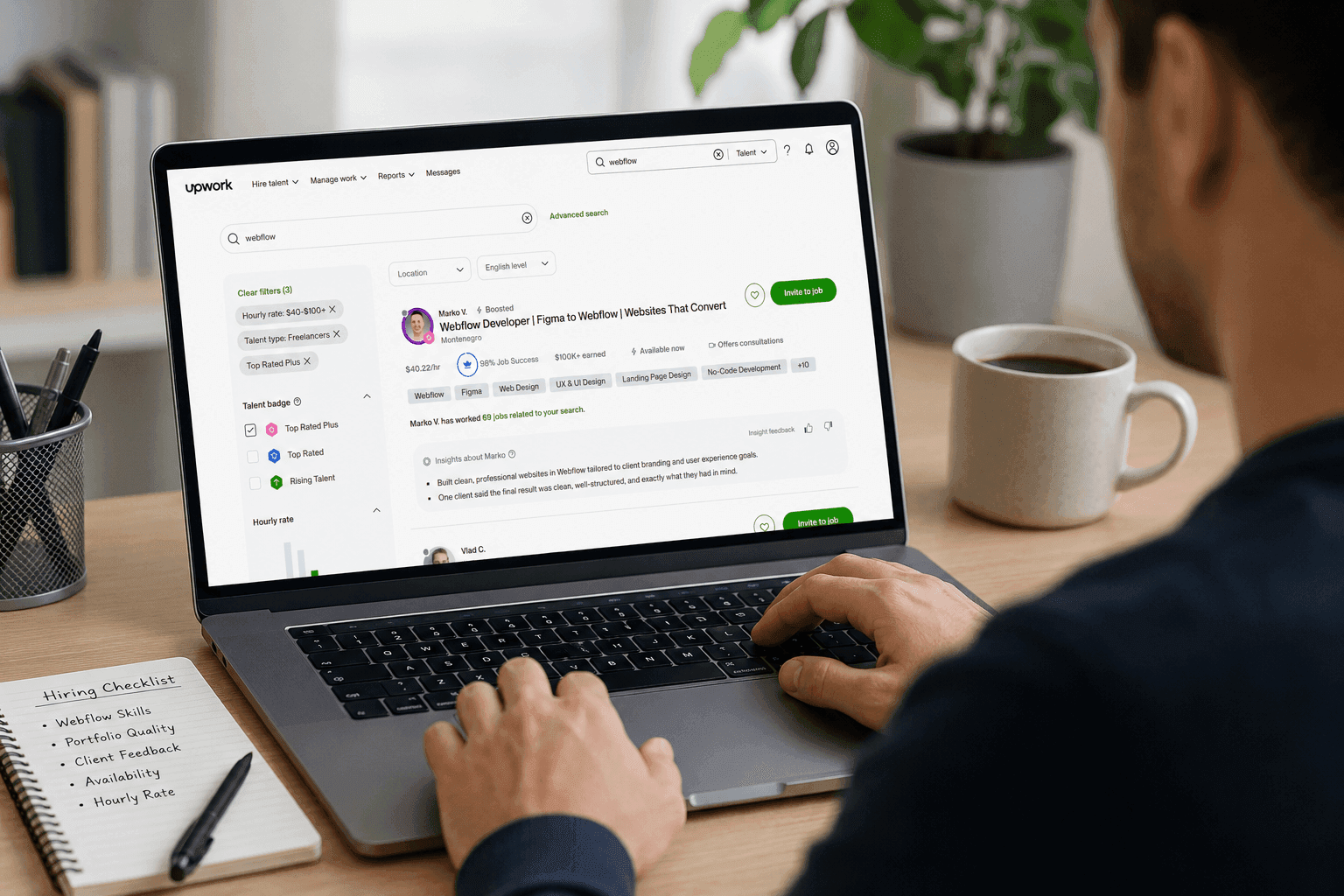
Yes, and for many smaller companies, a senior freelancer is the sweet spot between the two. For a full breakdown, read our Webflow freelancer vs agency guide and the freelance vs full-time Webflow developer comparison.
What happens to my site if I switch agencies or lose my in-house developer?
Ask this question before you sign anything. With an agency, confirm that you fully own the Webflow project, that documentation stays with you, and that offboarding is straightforward. With an in-house hire, invest early in written documentation, naming conventions, and a clean CMS architecture so the next person can ramp quickly.
How do I know if a Webflow agency is worth the price?
Look at live sites they've shipped in the last 12 months, not just case studies. Ask who specifically will work on your account and whether you can talk to them. Request a clear scope, a realistic timeline, and references from clients at a similar stage. A good agency will ask as many questions about your business as you ask about theirs.